You’ve picked your dream Cuisinart air fryer online, clicked “purchase,” and eagerly await its arrival—only to discover it won’t fit under your cabinets or blocks your stovetop access. This frustrating scenario happens daily because shoppers focus solely on cooking capacity while ignoring critical physical dimensions. Understanding the actual space requirements for your specific Cuisinart model prevents costly returns and kitchen chaos.
Unlike traditional appliances with standardized sizes, air fryers vary dramatically in footprint even within the same quart capacity class. A compact Cuisinart unit might slide neatly beside your coffee maker, while another “similar-sized” model could dominate half your counter. This guide cuts through the confusion by revealing exactly how to measure for your Cuisinart air fryer—without relying on misleading marketing claims. You’ll learn to calculate real-world space needs including ventilation clearances, handle protrusions, and basket extension zones that manufacturers often omit from specifications.
Why Stated Capacity Misleads Your Space Planning
Cuisinart’s advertised quart capacity refers only to the basket’s theoretical volume, not the appliance’s physical footprint. A 4-quart model from their Compact Series might occupy less counter space than a 3-quart unit from another brand due to engineering differences. The heating element placement—whether wrapped around the basket or positioned overhead—creates significant variations in height and width. Crucially, the usable cooking space is typically 15-20% smaller than advertised capacity since fill lines prevent overloading. Always prioritize exterior dimensions over capacity numbers when space is tight.
The Hidden Measurement Trap
Manufacturers often list only the base unit’s dimensions while ignoring critical protrusions:
– Basket handles extend 2-3 inches beyond the unit’s depth when pulled out
– Control knobs add 1 inch to the width on the operational side
– Ventilation grilles require additional clearance not reflected in height specs
– Door swing radius on oven-style models demands extra front clearance
Real-World Fit Failures
Customers frequently report these mismatch scenarios:
– Units too tall for standard 18-inch under-cabinet clearance despite listed height suggesting fit
– Basket extensions blocking adjacent appliances due to unaccounted pull-out space
– Rear cord placement interfering with wall outlets in compact kitchens
– Weight distribution causing instability when placed near counter edges
Critical Clearance Zones You Must Measure

Cuisinart air fryers require specific buffer zones for safe operation that dramatically increase their effective footprint. Ignoring these clearance requirements risks fire hazards, warranty voidance, and damaged cabinetry. The minimum safe distances apply to all models regardless of size class.
Ventilation Space Non-Negotiables
Above the unit: Maintain 6 inches minimum clearance (8 inches recommended) to prevent heat damage to overhead cabinets. This measurement starts from the topmost point including control panels—not just the main housing. Sides and rear: Allow 4 inches on left/right sides and 3 inches at the back for airflow. These zones become critical when placing units between appliances or against walls. Front workspace: Reserve 18 inches for basket removal—this includes the full extension arc plus room for your hands.
Under-Cabinet Installation Reality Check
Measure from your counter surface to the cabinet bottom, then subtract both the unit’s height and required clearance. Most standard 18-inch cabinets accommodate compact models (under 12 inches tall) but exclude larger units. Always test-fit with a cardboard template cut to your air fryer’s exact dimensions before purchasing. Remember that ceiling height variations in older homes often reduce clearance by 1-2 inches.
Weight Distribution Challenges by Size Class

The physical heft of Cuisinart air fryers impacts placement decisions beyond mere footprint considerations. Weight concentrates in the heating element assembly, creating balance challenges during movement. Shipping weights often exceed product weights by 20-30% due to packaging, complicating delivery in multi-story homes.
Lightweight Models Under 10 lbs
Compact personal units (2-3 quart capacity) feature integrated handles enabling single-handed movement. Their low weight allows flexible storage options—many users tuck these in upper cabinets when not in use. Verify handle strength though; some models develop stress cracks with frequent lifting.
Mid-Weight Units 10-18 lbs
Standard 4-6 quart models require two-handed carrying due to top-heavy design. The weight distribution makes them awkward to maneuver around kitchen obstacles. Never lift by the basket handle alone—this strains internal mechanisms. Plan permanent placement near your cooking zone to avoid daily relocation.
Heavy-Duty XL Units Over 18 lbs
Toaster-oven style models demand dedicated counter space. Their shipping boxes often exceed 30 pounds, creating return logistics nightmares. If your kitchen requires frequent appliance movement, skip XL models entirely—these belong on permanent countertops with reinforced cabinetry.
Basket Extension Realities You Can’t Ignore
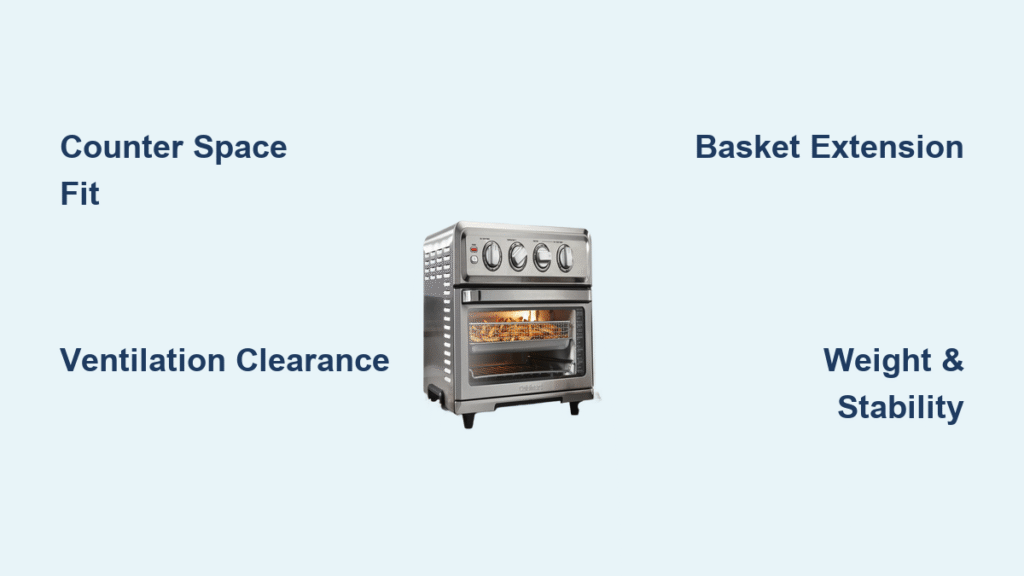
The space required for basket operation is frequently overlooked in dimension planning. When fully extended, most Cuisinart baskets project 60-70% beyond the unit’s base depth. This operational footprint determines your kitchen workflow viability.
Depth Requirement Calculation
Take the unit’s listed depth and add:
– 50% of the basket’s length for partial extension
– 100% of the basket’s length for full removal
– Additional 3 inches for comfortable handling
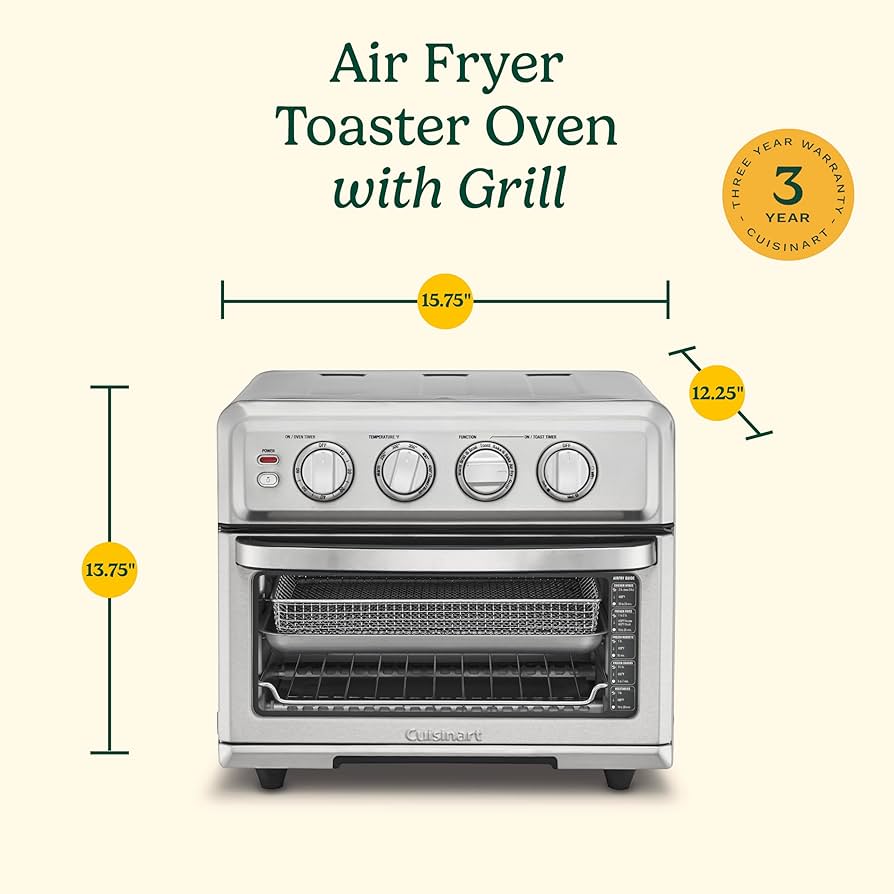
For example, a unit with 14-inch depth requires 21+ inches of clear counter depth for full basket access. Measure from the wall to any obstruction (like your stove backsplash) to verify clearance.
Handle Swing Radius Considerations
The basket handle’s arc during removal creates a semi-circular dead zone. Stand where you’d operate the unit and sweep your arm through the basket removal motion—this reveals hidden space conflicts with adjacent appliances or wall features. Oven-style models with downward-swinging doors need even more front clearance for safe operation.
Packaging Dimensions That Affect Your Decision
Retail boxes significantly exceed product dimensions, impacting delivery feasibility and storage options. Understanding packaging sizes prevents “it won’t fit through the door” disasters and helps plan for potential returns.
Box Size Multipliers
Expect packaging to add:
– 4-6 inches to height for top/bottom foam protection
– 3-4 inches per side for lateral cushioning
– 5 inches to depth for accessory compartments
– 3-5 pounds of non-recyclable plastic inserts
Storage Space Reality
Retain original packaging for warranty claims—it often requires the specific molded foam inserts. These boxes typically need 1.5x the unit’s footprint for storage. Compact model boxes fit under standard sinks, but XL unit packaging may require closet or garage storage. Measure your storage space against typical box dimensions before purchasing larger models.
The Pre-Purchase Measurement Checklist
Avoid costly mistakes by verifying these eight space factors before ordering any Cuisinart air fryer. Print this checklist and measure your kitchen with tape measure in hand—don’t rely on memory or estimated spaces.
Counter Space Verification Steps
- Clearance height: Measure from counter to cabinet bottom at the exact placement spot
- Depth buffer: Account for backsplash protrusions and outlet positions
- Side obstacles: Note refrigerator handles, knife blocks, or wall fixtures
- Front workspace: Ensure 18+ inches of unobstructed pull-out zone
- Cord routing: Trace path from outlet to unit location avoiding traffic areas
- Weight distribution: Confirm counter can support 25+ lbs at the edge
- Basket arc: Physically simulate removal path with your arms
- Future flexibility: Leave room for potential additions like baking pans
When to Choose Smaller Models
Opt for compact Cuisinart units if:
– Your under-cabinet clearance is under 14 inches
– Countertop depth is less than 20 inches
– You regularly cook for 1-2 people
– Storage space is extremely limited
– Weight restrictions exist (e.g., RVs or boats)
Final Placement Strategy for Long-Term Satisfaction
Your Cuisinart air fryer’s location impacts both safety and daily usability. The ideal spot balances clearance requirements with workflow efficiency—never sacrifice ventilation zones for convenience. Place the unit:
– At least 18 inches from water sources (sinks, dishwashers)
– On a heat-resistant surface away from flammable materials
– With rear ventilation unobstructed by walls or appliances
– Where basket removal doesn’t interfere with cooking movements
Remember that air fryers generate significant heat during operation—more than microwaves of similar size. If your kitchen has laminate countertops, use a silicone mat to prevent heat discoloration. For permanent installations, consider installing a dedicated outlet to eliminate cord clutter.
Pro Tip: Before final placement, run the unit empty for 10 minutes to observe heat patterns. Place your hand near ventilation zones—you should feel consistent airflow without intense hot spots indicating poor clearance.
Understanding these dimensional realities transforms your Cuisinart air fryer from a space-hogging nuisance into a seamlessly integrated kitchen asset. By measuring twice and purchasing once, you’ll enjoy crispy perfection without countertop chaos. Always consult your specific model’s manual for clearance requirements, as newer Cuisinart iterations may have unique spatial needs. When in doubt, choose a slightly smaller model—your future self will thank you when meal prep flows smoothly through your well-organized kitchen.