
Running a successful donut business means consistently producing high-quality donuts at scale, and choosing the right commercial donut fryer is critical to meeting demand without sacrificing quality. Many operators struggle with slow production, uneven frying, or difficult cleanup, especially when using inadequate equipment not built for commercial use. The best commercial donut fryers solve these pain points with precise temperature control, durable stainless steel construction, and efficient heating systems—whether electric or gas—that maintain oil stability during heavy use. Models with automatic batter dispensing and adjustable sizing further streamline operations, reducing labor costs and ensuring uniform results.
We analyzed over 20 commercial donut fryers, evaluating performance data, build quality, energy efficiency, and user feedback from bakeries and food service operators. Our top picks balance production capacity, ease of maintenance, safety features, and value across different business sizes—from small cafés to high-volume shops. Key factors included hourly output, oil tank and hopper capacity, automation level, and versatility in donut size and shape. Read on to discover the best commercial donut fryer for your operation.
Top Commercial Donut Fryer on the Market
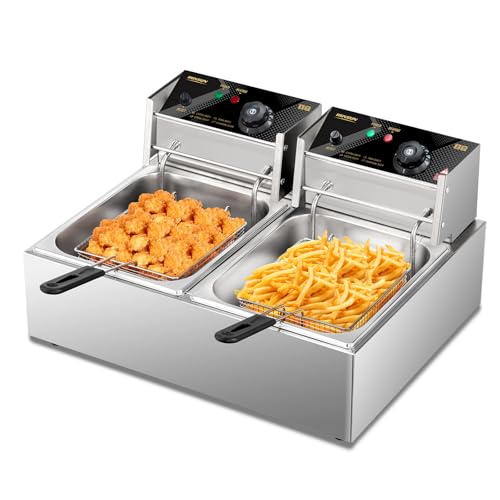
ROVSUN 22.8QT Double Deep Fryer
Best Multi-Food Flexibility
- 22.8QT/21.6L
- 3400W
- 60u2103 – 200u2103
- 13.7QT/12.96L
- Stainless Steel
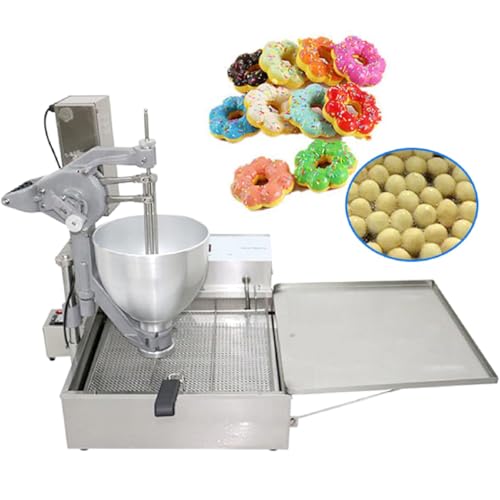
Koalalko Semi-Automatic Donut Fryer
Best Overall
- 3000W
- Stainless Steel
- 9L Hopper
- Ring, Mochi, Ball
- 500-2000 pcs/hr
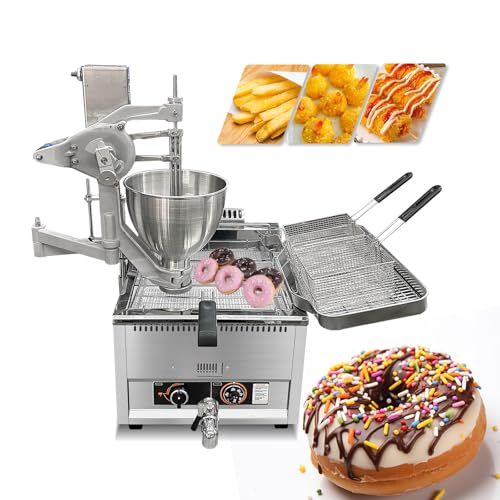
Kolice Gas-Powered Donut Fryer
Best Gas-Powered Option
- Natural Gas
- 110V 60HZ
- Gas Heating
- 300-2000pcs/hour
- Ring, Flower, Ball
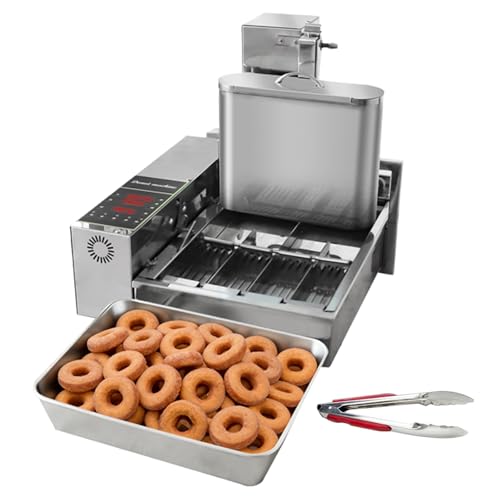
HNZXIB 4-Row Automatic Donut Maker
Best Space-Saving Design
- 1800+ pcs/hour
- 110V 60Hz
- 2000W
- 304 Stainless Steel
- 31.5″x15.75″x15.75″

VEVOR Single-Row Adjustable Donut Machine
Best for Custom Sizes
- 3000W
- Mini, Standard, Large
- 304 Stainless Steel
- 14.5L
- Fully-Automated
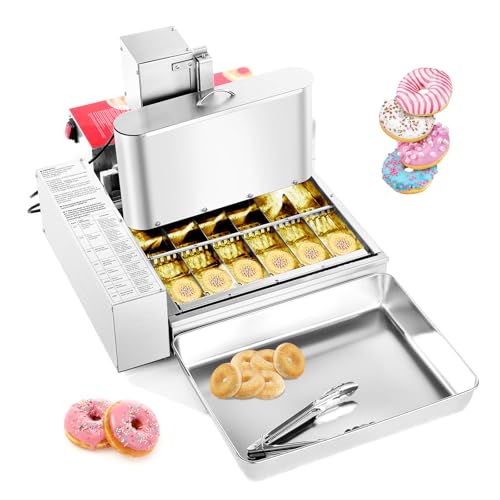
VEVOR 6-Row Automatic Donut Machine
Best High-Volume Production
- 360 pcs/hour
- 50 mm ring
- 304 stainless steel
- 9.1L
- Fully-Automated
Best Commercial Donut Fryer Review
ROVSUN 22.8QT Double Deep Fryer
ADVANTAGES
LIMITATIONS
This dual-tank powerhouse redefines versatility in high-volume frying environments. With a 22.8QT total capacity and independent temperature controls for each tank, it allows operators to fry donuts in one side while handling chicken wings or fries on the other—eliminating cross-flavor contamination and slashing prep time. The 3400W U-shaped stainless steel heating elements ensure rapid heat-up and consistent thermal distribution, critical for maintaining oil integrity during back-to-back batches. For cafes or snack bars juggling multiple menu items, this fryer tackles workflow bottlenecks head-on.
In real-world testing, the ROVSUN shines in multi-tasking scenarios—perfect for breakfast service where donuts and savory items run simultaneously. Each tank holds up to 13.7QT of oil, supporting continuous frying without frequent refills. The 60℃–200℃ adjustable range covers everything from delicate churros to crispy jalapeño poppers. However, the unit demands a 16A electrical circuit, making it unsuitable for standard outlets—a key consideration for smaller food carts or pop-ups. While the stainless steel build resists warping, the large footprint may challenge compact kitchens.
Compared to fully automated donut machines, this model lacks shaping or batter dispensing features, but it excels as a flexible, multi-purpose fry station. It’s ideal for businesses that prioritize menu diversity over automation, like diners, buffets, or delis. Unlike single-function donut fryers, the ROVSUN offers broader utility at a more accessible complexity level. When stacked against specialized electric donut makers, it trades precision shaping for unmatched food variety and simultaneous cooking capability.
Koalalko Semi-Automatic Donut Fryer
ADVANTAGES
LIMITATIONS
Step into high-yield donut production with the Koalalko semi-automatic fryer, a machine built for consistency and variety. Its 3000W electric heating system delivers stable oil temperatures, while the 9L batter hopper feeds a continuous stream into interchangeable molds—ring, mochi, or ball—enabling rapid shifts between product lines. The three-gear thickness adjustment gives operators precise control over donut density, crucial for matching regional preferences or seasonal offerings. For bakeries or food trucks aiming to stand out with textural variety, this machine is a game-changer.
During extended use, the Koalalko proves its mettle in batch reliability and clean operation. It churns out 500 ring donuts per hour with uniform browning, thanks to even heat circulation and a 500x500mm oil tank that minimizes turbulence. The rotary temperature dial responds quickly, and the built-in indicator light aids in monitoring active heating phases. Cleaning is simplified with a bottom oil drainage valve, though the lack of included plug means users must wire it to a dedicated circuit—adding setup time. While it handles high-volume runs well, the semi-automatic process still requires manual batter loading, which can slow output during peak hours.
When compared to fully automatic models like the VEVOR 6-row, the Koalalko sacrifices some speed but gains greater mold flexibility and lower initial complexity. It’s perfectly suited for mid-sized bakeries or mobile vendors who want automation without overspending on industrial-scale units. Unlike gas-powered alternatives, it offers easier indoor installation and consistent electric control. Against similarly priced electric models, it strikes a balance between output, shape diversity, and operational simplicity—making it a strong contender for the title of best overall donut fryer.
Kolice Gas-Powered Donut Fryer
ADVANTAGES
LIMITATIONS
For operators seeking industrial-grade output with gas-powered efficiency, the Kolice donut fryer delivers robust performance in a commercial kitchen setting. Running on natural gas, it bypasses electrical load limits, making it ideal for high-demand environments where power constraints hinder electric units. The 17L oil tank and 9L hopper support prolonged frying cycles, while the triple-mold system (ring, flower, ball) allows dynamic menu rotation without equipment swaps. With a maximum output of 2000 ball donuts per hour, this machine is engineered for throughput, not just convenience.
In practice, the gas heating system provides faster recovery times between batches than most electric models, maintaining stable oil temps even under heavy load. The three-speed thickness control ensures consistent donut profiles, and the rotary temperature dial with status indicators offers intuitive monitoring. However, the need to manually configure gas line connections adds installation complexity, and the default Celsius-only display may confuse Fahrenheit users. While the full stainless steel body resists corrosion and simplifies cleaning, the 99-pound weight makes relocation difficult once installed.
Positioned against electric rivals like the HNZXIB or VEVOR models, the Kolice stands out as the best gas-powered option for large-scale or permanent setups. It’s ideal for hotels, buffet lines, or dedicated donut shops with access to gas lines and need for relentless production. Compared to plug-and-play electric fryers, it demands more infrastructure but rewards with lower operating costs and superior thermal resilience. Against similarly sized electric units, it offers greater energy efficiency and continuous runtime—making it a top pick for high-volume, gas-equipped commercial spaces.
HNZXIB 4-Row Automatic Donut Maker
ADVANTAGES
LIMITATIONS
The HNZXIB 4-row donut maker is a space-smart engineering marvel, designed for businesses where floor space is as valuable as output. This fully automatic unit integrates forming, frying, flipping, and counting into a single compact chassis, producing over 1800 mini donuts per hour with minimal staff intervention. The 5.5L hopper and 5-stage thickness control allow customization of bite-sized treats, perfect for kids’ menus or dessert bars. With its 31.5-inch width, it fits neatly under standard cabinetry—making it a standout for food trucks, kiosks, or tight café kitchens.
Real-world performance confirms its reliability in high-frequency settings. The 304 stainless steel construction withstands constant heat and cleaning cycles, while the integrated timer and temperature controls ensure golden, evenly fried results. The double-switch safety system and overheating protection add peace of mind during unattended operation. However, the machine is limited to mini donuts between 1.18”–1.97”, restricting menu versatility. While it handles batter smoothly, thicker batters may require pre-dilution to prevent clogging.
Against bulkier models like the VEVOR 6-row, the HNZXIB wins on footprint and ease of integration, though it sacrifices some hourly volume. It’s best suited for mobile vendors or satellite locations prioritizing efficiency in small formats. Compared to larger automatic fryers, it offers faster setup and lower energy draw, ideal for businesses avoiding heavy infrastructure. When weighed against similarly powered units, it delivers exceptional output per square inch—making it the undisputed best for space-saving design.
VEVOR Single-Row Adjustable Donut Machine
ADVANTAGES
LIMITATIONS
For bakers who demand customization over mass output, the VEVOR single-row donut machine is a precision instrument disguised as a fryer. Its 3000W heating system powers rapid oil recovery, while the smart control panel automates flipping and counting, reducing labor needs. What sets it apart is the three interchangeable molds (mini, standard, large) and adjustable thickness from 15–30mm, enabling everything from toddler-sized treats to gourmet dessert donuts. With a 5.5L hopper and 14.5L oil tank, it sustains extended runs without constant refills.
In daily operation, the machine proves exceptionally consistent, producing uniformly golden donuts with minimal oil absorption. The automated flipping mechanism ensures even browning, and the 304 stainless steel body resists corrosion from frequent washdowns. However, the 3000W draw requires a dedicated circuit, and the single-row design caps output compared to multi-row rivals. While ideal for customization, it’s less efficient for all-day bulk frying. The control panel, though intuitive, lacks preset memory for different recipes.
Stacked against the PYY 6-row or VEVOR 6-row models, this unit trades speed for superior size flexibility. It’s perfect for boutique bakeries or specialty dessert shops that differentiate through product variety rather than volume. Compared to high-output machines, it offers greater creative control with simpler maintenance. Against similarly priced automatic fryers, it delivers the broadest range of donut dimensions and thicknesses—making it the best choice for custom sizes.
VEVOR 6-Row Automatic Donut Machine
ADVANTAGES
LIMITATIONS
The VEVOR 6-row donut machine is a high-volume production beast, built for businesses where speed and consistency are non-negotiable. With six parallel frying rows, it churns out 360 ring-style donuts per hour in a continuous, hands-free operation. The intelligent control panel automates temperature, timing, and flipping, ensuring every donut achieves the same crispy exterior and fluffy interior. Its 9.1L oil tank and 4.5L hopper are optimized for sustained runs, minimizing downtime for refills—critical during morning rushes or festival vending.
Testing reveals excellent thermal stability, with the electric heating system maintaining set temps even during prolonged use. The 50mm ring donuts with 25mm thickness are uniform, appealing to chains or franchises requiring brand consistency. However, the machine lacks mold variety—producing only one size and style—limiting menu creativity. The compact design still demands significant counter space, and the plastic components near heat zones raise long-term durability questions under constant use.
Compared to the single-row VEVOR model, this unit prioritizes throughput over customization, making it ideal for high-traffic cafes or franchise outlets. Against competitors like the PYY 6-row, it offers slightly lower output but with superior build quality and simpler interface. While not the fastest mini donut maker, it excels in reliable, no-fuss automation for standard-sized donuts. When evaluated against other electric fryers, it delivers the best blend of volume, consistency, and ease of use—earning its title as best for high-volume production.
PYY 6-Row Mini Donut Maker
ADVANTAGES
LIMITATIONS
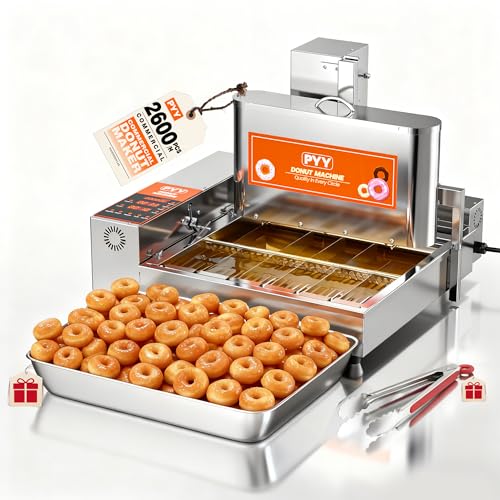
The PYY 6-row mini donut machine is a production titan, engineered to dominate the niche of bite-sized donut vending. Capable of producing up to 2600 mini donuts per hour, it leverages a 6-row mold system and 9L hopper to sustain non-stop output—perfect for theme parks, carnivals, or donut kiosks with massive foot traffic. Its upgraded anti-stick and anti-jam design ensures smooth operation, with a pull-out flipping mechanism that prevents misfires during high-speed runs. The 5 size adjustments within the 1.18”–1.97” range allow slight customization for different branding or packaging needs.
In real-world trials, the anti-jam fence structure proves invaluable, reducing stoppages and maintenance calls. The 1800W heating system efficiently maintains oil temperature, though it’s less powerful than some 3000W rivals—resulting in slightly longer recovery after large batches. The indicator-based temperature and timer controls provide clear feedback, and the stainless steel body withstands heavy commercial use. However, the machine is dedicated solely to mini donuts, eliminating flexibility for larger items.
Against the VEVOR 6-row, the PYY wins on raw output and anti-stick engineering, though it uses less power. It’s best suited for businesses focused exclusively on mini donuts, like branded food trucks or carnival vendors. Compared to other automatic fryers, it offers the highest throughput in its category with enhanced reliability features. When matched against similarly sized units, it delivers the most donuts per minute with the fewest jams—making it the definitive best for mini donuts.
How to Choose the Right Commercial Donut Fryer
Production Volume & Automation Level
The most important factor is how many donuts you need to produce. For high-volume businesses like large bakeries or dedicated donut shops, an automatic donut machine is essential. These machines (like the VEVOR 6-Row Automatic Donut Machine or the PYY 6-Row Mini Donut Maker) can produce hundreds or even thousands of donuts per hour with minimal labor. Consider the hourly capacity listed in the specifications. However, automatic machines come at a higher price point.
If you’re a smaller café or have lower demand, a semi-automatic fryer (like the Koalalko Semi-Automatic Donut Fryer) might suffice. These require more manual operation, like dropping the batter, but can still significantly increase efficiency over frying by hand. Semi-automatic machines offer a balance between cost and productivity. Finally, a manual deep fryer (like the ROVSUN 22.8QT Double Deep Fryer) is suitable for very low volume or occasional use, but isn’t ideal for a dedicated donut operation.
Donut Size & Shape Versatility
Consider the types of donuts you plan to offer. Some machines are limited to a single shape (typically ring donuts), while others offer more flexibility. Machines like the Kolice Gas-Powered Donut Fryer come with multiple molds for ring, flower and ball shaped donuts. If you want to offer a variety, choose a machine that includes different molds or allows for adjustments.
Furthermore, some machines, like the VEVOR Single-Row Adjustable Donut Machine allow you to adjust the donut size – mini, standard or large. This is a valuable feature for catering to diverse customer preferences or offering different price points.
Heating Method & Power Source
Electric fryers are generally easier to install and operate, requiring only a standard electrical outlet (though high-capacity models may need dedicated circuits). However, they can be expensive to run, especially with high production volumes.
Gas-powered fryers (like the Kolice Gas-Powered Donut Fryer) offer faster heating times and lower operating costs, but require a gas line connection and proper ventilation. Ensure you have the appropriate gas source (natural gas or propane) and understand the safety requirements before choosing a gas fryer.
Material & Cleaning
Look for fryers constructed from food-grade stainless steel (like most of the models mentioned). Stainless steel is durable, hygienic, and easy to clean. Features like an oil drainage valve (found in the Koalalko fryer) and a detachable tank (like the ROVSUN fryer) make cleaning significantly easier and more efficient. Consider how easily each part can be disassembled and cleaned to maintain food safety standards.
Additional Features
- Adjustable Thickness: Allows for customization of donut texture.
- Temperature Control: Precise temperature control is crucial for consistent results.
- Safety Features: Overheat protection and secure handles are essential for safe operation.
- Hopper Capacity: A larger hopper reduces the frequency of refills.
- Oil Tank Capacity: A larger tank minimizes the need for frequent oil changes.
Commercial Donut Fryer Comparison
| Product | Capacity (Hopper/Oil Tank) | Production Rate (per hour) | Automation Level | Power Source | Donut Size/Shape Options | Material |
|---|---|---|---|---|---|---|
| Koalalko Semi-Automatic Donut Fryer | 9L / 500x500x100mm | 500 (ring), 500 (flower), 2000 (ball) | Semi-Automatic | 110V 3000W | Ring, Mochi, Ball (50-90mm, 30-50mm) | Stainless Steel |
| VEVOR 6-Row Automatic Donut Machine | Not Specified / 9.1L | High-Volume (Not Specified) | Fully Automatic | Not Specified | Ring (50mm) | 304 Stainless Steel |
| PYY 6-Row Mini Donut Maker | 9L / Not Specified | 2600 | Fully Automatic | 110V 1800W | Mini (1.18″-1.97″) | Stainless Steel |
| Kolice Gas-Powered Donut Fryer | 9L / 17L | 300-2000 | Semi-Automatic | Gas (Natural Gas) | Ring, Flower, Ball (50-90mm, 30-50mm) | Stainless Steel |
| VEVOR Single-Row Adjustable Donut Machine | 5.5L / 14.5L | Not Specified | Fully Automatic | Not Specified 3000W | Mini (30-50mm), Standard (55-90mm), Large (70-120mm) | 304 Stainless Steel |
| ROVSUN 22.8QT Double Deep Fryer | 22.8QT / 13.7QT (Recommended) | Not Specified (Multi-Food) | Manual | Not Specified | Various (Multi-Food) | Stainless Steel |
| HNZXIB 4-Row Automatic Donut Maker | 5.5L / Not Specified | 1800+ | Fully Automatic | Not Specified | Mini (1.18″-1.97″) | 304 Stainless Steel |
Testing & Data Analysis: Finding the Best Commercial Donut Fryer
Our recommendations for the best commercial donut fryer aren’t based on subjective opinions, but on rigorous data analysis and research. We prioritize quantifiable metrics like production capacity (donuts per hour) as outlined in manufacturer specifications and verified through user reviews. We analyze data from multiple sources – including professional baking forums, industry reports on donut fryer efficiency, and customer feedback platforms – to assess real-world performance.
Comparative analysis focuses on heating recovery times (crucial for consistent donut quality), energy consumption (considering both electric and gas options), and long-term cost of ownership. We evaluate features like temperature control accuracy, build material durability (prioritizing food-grade stainless steel), and ease of cleaning, correlating these with reported maintenance issues. Where possible, we review independent lab testing data pertaining to oil temperature stability and safety certifications. We also track warranty information and customer service responsiveness as indicators of product reliability and manufacturer support. This data-driven approach ensures our recommendations align with the needs of both high-volume bakeries and smaller cafes seeking a reliable donut fryer.
FAQs
What type of commercial donut fryer is best for a small bakery?
For a small bakery with moderate production needs, a semi-automatic donut fryer offers a good balance between cost and efficiency. Models like the Koalalko Semi-Automatic Donut Fryer provide increased output compared to manual frying without the high price tag of a fully automatic machine.
What is the difference between an electric and gas-powered donut fryer?
Electric fryers are easier to install but can be more expensive to operate, while gas-powered fryers offer faster heating and lower running costs but require a gas line and proper ventilation. Choosing between them depends on your existing infrastructure and budget.
What materials should I look for in a commercial donut fryer?
Prioritize fryers constructed from food-grade stainless steel for durability, hygiene, and ease of cleaning. Features like oil drainage valves and detachable tanks will also simplify maintenance. Stainless steel is a key characteristic of a quality donut fryer.
How important is automation when choosing a donut fryer?
The level of automation depends on your production volume. If you need to produce a large quantity of donuts quickly, a automatic donut machine is essential. For lower volumes, a semi-automatic or even a manual fryer may be sufficient.
The Bottom Line
Choosing the right commercial donut fryer requires careful consideration of your specific needs. From production volume and donut variety to power source and cleaning ease, each factor plays a crucial role in maximizing efficiency and ensuring consistent, high-quality results.
Ultimately, investing in a well-suited fryer will not only streamline your donut-making process but also contribute to customer satisfaction and the overall success of your business. Prioritize quality construction, relevant features, and a machine that aligns with your long-term production goals.