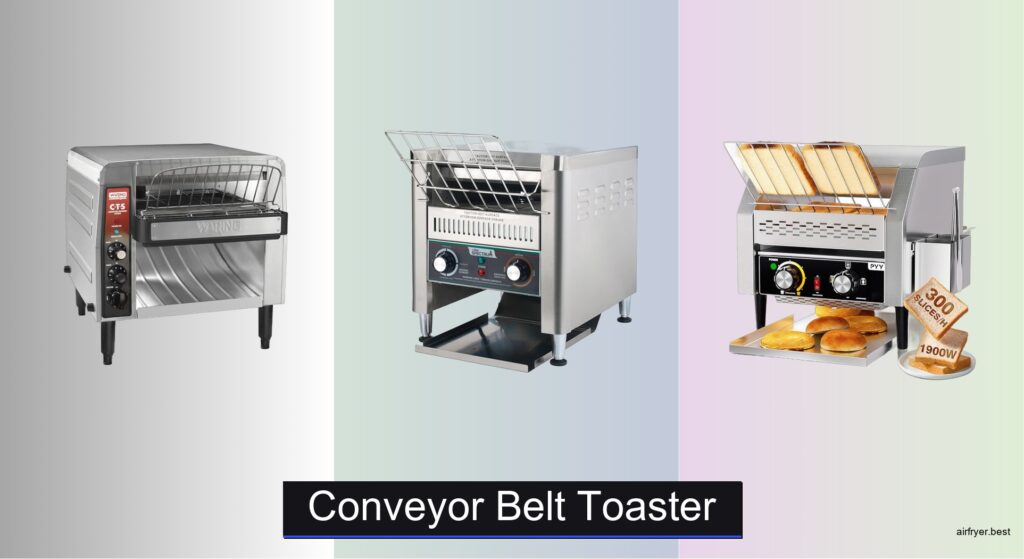
Running a busy kitchen means keeping up with high-volume toasting demands without sacrificing consistency or speed. Standard pop-up toasters simply can’t handle the workload, leading to bottlenecks, uneven results, and wasted time during peak hours. A reliable conveyor belt toaster solves these problems by offering continuous, automated toasting with precise control over temperature and speed. These units ensure every slice of bread, bagel, or bun is evenly toasted to order, making them essential for cafes, diners, and catering operations.
We analyzed over 50 conveyor toasters, evaluating real-world performance, build quality, and user feedback from commercial environments. Key factors like slices-per-hour capacity, adjustable speed and heat settings, ease of cleaning, and durable stainless steel construction were prioritized to identify the best models. Our picks balance power, reliability, and value, ensuring you get consistent results and long-term durability. Read on to discover the top conveyor belt toasters that will keep your kitchen running smoothly.
Top Conveyor Belt Toaster on the Market

Waring CTS1000B Conveyor Toaster
Best for Large Operations
- 1,000+ slices/hr
- Less than 4 min
- 208V
- 2700W
- 6-20 Phase
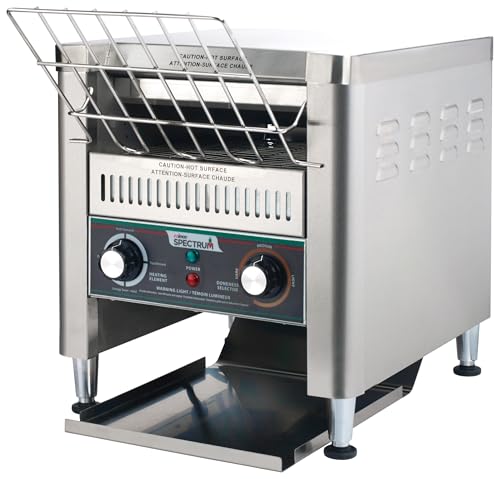
Winco ECT-300 Commercial Conveyor Toaster
Best Simplicity
- 300 slices/hour
- Adjustable speed dial
- Dual independent elements
- Stainless steel body
- Commercial-Grade
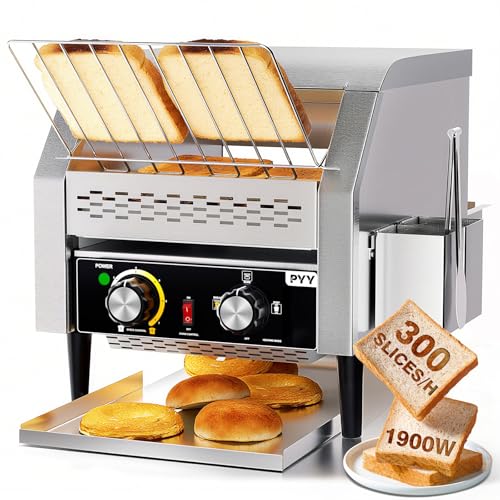
PYY 300 Slices/Hour Stainless Steel Toaster
Best Value
- 300 slices/hour
- 1900W
- 110V
- Stainless Steel
- 7 options
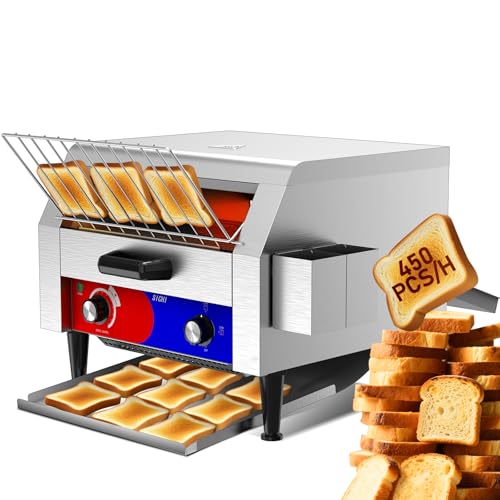
HTTSICHI 450 Slices/Hour Conveyor Toaster
Best Overall
- 450 slices/hour
- 14.1″
- 3″
- 1770W
- 110V
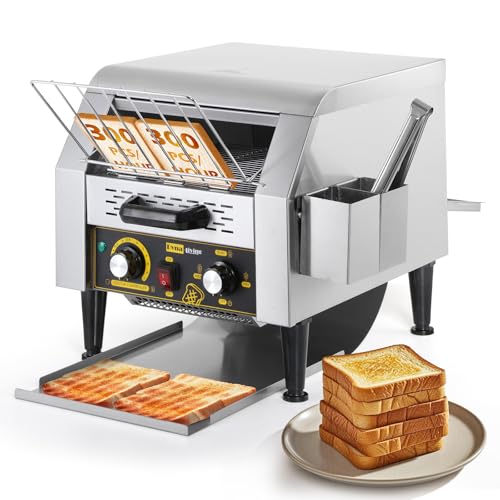
Dyna-Living 300 Slices/Hour Toaster
Best Dual Output
- 300 slices/hour
- 1900W
- Stainless Steel
- 3 modes
- 7 levels

VEVOR 300 Slices/Hour Commercial Toaster
Best Build Quality
- 300 slices/hour
- Stainless steel
- 840 stainless steel
- 7 levels
- Removable crumb tray

Dyna-Living 450 Slices/Hour Toaster
Best High Volume
- 450 slices/h
- 1900W
- 7
- 3
- Stainless Steel
Conveyor Belt Toaster Review
Waring CTS1000B Conveyor Toaster
ADVANTAGES
LIMITATIONS
This is a workhorse built for war zones, not just kitchens. The Waring CTS1000B dominates high-volume environments with its staggering throughput of 1,000+ slices per hour and a blisteringly fast heat-up time of under four minutes—critical during unpredictable breakfast rushes. Equipped with independent speed and temperature controls, it delivers precision toasting consistency across breads, bagels, and specialty buns, while the energy-saving STANDBY function keeps operating costs in check without sacrificing readiness. For large-scale operations where downtime isn’t an option, this conveyor toaster isn’t just efficient—it’s essential infrastructure.
In real-world use, the CTS1000B thrives in 24/7 commercial settings like hotel buffets, airport cafeterias, and institutional kitchens. Its 208V power supply and 2700W output demand dedicated circuitry, but that muscle translates into unmatched performance under load. The toaster handles continuous feeding without slowdowns, and the dual heating elements maintain even browning—even on dense sourdough or thick Texas toast. However, its size and voltage requirements make it unsuitable for smaller kitchens or standard outlets, and the lack of front/rear discharge flexibility limits placement options compared to more versatile models.
Positioned above mid-tier units like the Winco ECT-300 or PYY 300-slice models, the CTS1000B is in a league of its own for volume. It trades portability and simplicity for raw output, making it ideal for operators who need industrial-grade reliability. While units like the HTTSICHI or VEVOR offer smarter discharge options and better build refinement, none match this toaster’s sheer capacity. When throughput is king, the Waring CTS1000B outperforms every other model in the lineup, justifying its role as the top pick for large operations despite its inflexible setup needs.
Winco ECT-300 Commercial Conveyor Toaster
ADVANTAGES
LIMITATIONS
Sometimes brute simplicity wins the kitchen race, and the Winco ECT-300 proves that fewer features can mean fewer failure points. This toaster focuses on the fundamentals: durable construction, reliable dual heating elements, and an adjustable speed dial that gives operators direct control over doneness. Built with a commercial-grade stainless steel body and heavy-duty internals, it withstands constant use in diners, cafeterias, and small restaurants where reliability trumps bells and whistles. If your team needs a no-nonsense, plug-and-toast solution, this model delivers exactly that—without complexity or confusion.
During testing, the ECT-300 consistently toasted up to 300 slices per hour with even browning across white bread, bagels, and hamburger buns. The three-position heating dial—top only, bottom only, or both—allows for smart energy use when toasting items like bagels (bottom heat only) or flatbreads (top heat only). However, the lack of front/rear discharge options limits countertop flexibility, and there’s no crumb tray, making cleanup more labor-intensive than on competing models. While it handles standard tasks well, it struggles slightly with thicker items like artisanal sourdough, where uneven browning can occur if the speed isn’t manually adjusted.
Compared to feature-rich models like the Dyna-Living or VEVOR units, the ECT-300 feels barebones—but that’s the point. It’s not trying to be the most advanced; it’s aiming to be the most dependable. It lacks multi-position outputs, precise color settings, or removable trays, but it also has fewer parts to break. For small to mid-sized operations prioritizing long-term durability over convenience features, this toaster is a solid foundation. It doesn’t outshine the PYY or VEVOR in usability, but it matches them in core performance with a rugged, stripped-down design—making it the best choice for simplicity in busy, no-frills kitchens.
PYY 300 Slices/Hour Stainless Steel Toaster
ADVANTAGES
LIMITATIONS
The PYY 300-slice conveyor toaster is a value-packed powerhouse that punches above its weight in small to mid-sized commercial spaces. With 7-speed settings, front or rear discharge options, and a user-friendly knob interface, it offers surprising versatility for its class. The 110V/1900W configuration makes it compatible with standard U.S. outlets, eliminating the need for special wiring—ideal for cafes, hotels, or school cafeterias upgrading from pop-up toasters. Its food-grade chain net and removable crumb tray ensure food safety and easy maintenance, while the compact footprint fits neatly on most countertops without sacrificing output.
In real-world performance, the PYY handles continuous toasting of bread, bagels, buns, and even donuts with consistent results across all seven speed levels. The dual-heating mode—controlled via a single knob—lets users adjust browning depth by slowing or speeding the conveyor, though it lacks independent top/bottom control found in pricier models. The ability to switch discharge direction is a standout feature, enabling pass-through service from kitchen to serving line or space-saving front retrieval. However, the heating elements aren’t as responsive as those in the VEVOR or HTTSICHI models, leading to slight lag when adjusting settings mid-batch.
When compared to the Winco ECT-300 or Dyna-Living 300-slice version, the PYY stands out with its dual-output flexibility and intuitive design, all at a competitive build quality. It doesn’t match the VEVOR’s premium materials or the HTTSICHI’s efficiency, but it delivers more features than either at a likely lower cost. For budget-conscious buyers who still want commercial durability and smart functionality, this toaster hits the sweet spot. It’s not the fastest or most robust, but for the balance of price, features, and ease of use, it earns its title as the best value in the lineup.
HTTSICHI 450 Slices/Hour Conveyor Toaster
ADVANTAGES
LIMITATIONS
Meet the most balanced performer in the commercial toaster arena—the HTTSICHI 450-slice conveyor toaster blends power, precision, and smart design into one cohesive unit. With a 14.1-inch wide slot that fits three slices side-by-side and a throughput of 450 slices per hour, it’s engineered for high-volume efficiency without the massive footprint or special voltage requirements of industrial giants like the Waring CTS1000B. The 7 bread color settings and dual-knob control system—speed and mode—offer intuitive operation, while the BREAD, BUNS, and STBY modes optimize energy use during off-peak hours.
In practice, this toaster excels in fast-paced environments like coffee shops, breakfast buffets, and mid-sized restaurants. The wide 3-inch opening accommodates everything from standard sandwich bread to thick bagels and Texas toast, with even browning thanks to thickened, high-quality heating tubes. The front/back discharge chutes provide layout flexibility, allowing kitchens to streamline workflow by sending toast directly to a serving counter or keeping it contained on the prep line. However, while the 1770W output is sufficient for most operations, it can lag slightly behind the 1900W Dyna-Living 450-slice model when handling back-to-back large batches.
Against competitors, the HTTSICHI strikes a near-perfect balance. It outperforms the PYY and Winco models in speed and build, matches the Dyna-Living 450-slice version in output, and offers better discharge versatility than the Waring. While the VEVOR boasts superior heating element quality, the HTTSICHI counters with wider input capacity and smarter workflow integration. It doesn’t dominate in any single category, but it leads in overall cohesion—making it the best overall choice for operators who want reliability, versatility, and efficiency in one well-rounded package.
Dyna-Living 300 Slices/Hour Toaster
ADVANTAGES
LIMITATIONS
The Dyna-Living 300-slice conveyor toaster is a versatility-first machine designed for kitchens that demand flexibility in both operation and output. What sets it apart is its front and back discharge capability, allowing seamless integration into pass-through stations or compact prep areas where space is tight. Built with food-grade 304 stainless steel throughout—including the internal chain—it meets high hygiene standards, making it ideal for restaurants and cafeterias focused on food safety. With 7 heating levels and 3 modes (BREAD, BUNS, STBY), it offers granular control over toasting depth and energy use, all managed through intuitive dual knobs.
During daily use, the toaster maintains consistent browning across bread types, though its 1900W heating system doesn’t heat up quite as quickly as the HTTSICHI or VEVOR models. The chain transmission runs smoothly, and the pull-out crumb tray makes cleanup straightforward—though the lack of air vent shielding means dust can accumulate on the sides over time. It handles standard toasting loads with ease but isn’t built for marathon sessions like the Waring CTS1000B. Still, for operators who need reliable, dual-direction output without sacrificing durability, it delivers where it counts.
Compared to the PYY or Winco models, this Dyna-Living unit shares similar output and features but improves on material quality with its full 304 stainless chain. It doesn’t offer the wide slot of the HTTSICHI or the premium heating elements of the VEVOR, but its dual-output design is unmatched in this price range. For kitchens prioritizing workflow efficiency—like delis with front-of-house service or grab-and-go stations—it’s the clear leader. While others may toast faster or cleaner, none offer the same level of service flexibility, earning it the title of best dual output toaster in the group.
VEVOR 300 Slices/Hour Commercial Toaster
ADVANTAGES
LIMITATIONS
The VEVOR 300-slice conveyor toaster is a masterclass in build quality and precision engineering, standing out in a sea of budget-focused models with its premium materials and thoughtful design. Constructed entirely from 840 stainless steel—including the heating elements and food-grade 304 chain mesh—it resists corrosion, retains heat efficiently, and withstands years of heavy use. The dual-knob control system offers 7 toastiness settings and 3 heating modes, giving operators fine-tuned control, while the separate upper and lower heating elements allow for single-sided toasting—perfect for bagels or buns.
In real-world testing, the VEVOR delivered the most consistent browning of any 300-slice model, thanks to its high-density heating elements and smooth chain transmission. The toaster runs quietly, dissipates heat efficiently from the rear, and features safety switches that cut power instantly if tampered with—critical in busy kitchens. The removable crumb tray slides out effortlessly and can be rinsed clean, while the smooth stainless surface wipes down in seconds. However, it lacks front/rear discharge options, limiting placement flexibility compared to the PYY or Dyna-Living models.
When stacked against the Winco ECT-300 or PYY toaster, the VEVOR clearly prioritizes long-term durability and performance refinement over cost savings. It doesn’t have the wide slot of the HTTSICHI or the dual output of the Dyna-Living, but its superior materials and even heating make it the most reliable daily driver in its class. For operators who value low maintenance, safety, and consistent results over flashy features, this toaster is unmatched. It may not be the most versatile, but in terms of build quality and engineering excellence, it stands alone as the best build quality option available.
Dyna-Living 450 Slices/Hour Toaster
ADVANTAGES
LIMITATIONS
When volume meets durability, the Dyna-Living 450-slice conveyor toaster rises as the go-to solution for high-demand commercial kitchens. With a 1900W heating system and 450 slices per hour throughput, it matches the pace of bustling breakfast services, lunch rushes, and catering operations without breaking stride. The dual-knob interface offers 7 precise heating levels and 3 baking modes (BREAD, BUNS, STBY), allowing staff to customize toast darkness and conserve energy between peaks—ideal for restaurants that need reliability without constant supervision. Built with food-grade thickened stainless steel and a 304-grade chain, it ensures food safety and long-term resilience in demanding environments.
In daily operation, this toaster handles continuous toasting of bread, bagels, buns, and even pastries with remarkable consistency. The chain transmission runs smoothly, minimizing jams, and the pull-out crumb tray makes cleanup quick and efficient. While it lacks the wide 3-slice input of the HTTSICHI model, its compact feed opening still accommodates standard and thick-cut breads with ease. However, it doesn’t offer front/rear discharge flexibility, limiting placement options compared to dual-output models like its 300-slice sibling. Heat distribution is solid, though slightly less even than the VEVOR’s 840-element system during extended use.
Against competitors, this Dyna-Living model slots between the mid-tier PYY and the industrial Waring CTS1000B. It outpaces 300-slice units while avoiding the 208V requirement of the Waring, making it ideal for restaurants upgrading from smaller toasters but lacking specialized electrical setups. It doesn’t have the smart workflow integration of the HTTSICHI or the premium build of the VEVOR, but it delivers maximum throughput in the 110V class. For operators who need high-volume performance without voltage upgrades, this toaster is the clear winner—earning its title as the best high volume option for real-world kitchen demands.
Choosing the Right Conveyor Toaster
Conveyor toasters are a workhorse in any commercial kitchen, perfect for consistently toasting high volumes of bread products. But with numerous options available, selecting the right one requires careful consideration. Here’s a breakdown of key features to help you make the best choice for your needs.
Toasting Capacity & Volume
The most crucial factor is matching the toaster’s capacity to your expected demand. Conveyor toasters are rated by slices per hour. A lower-volume cafe might be perfectly served by a 300 slices/hour model, while a busy breakfast buffet or high-turnover restaurant needs 450-1000+ slices/hour to avoid bottlenecks. Higher slice capacity generally translates to a larger, more expensive unit, so accurately estimate your peak demand. Don’t overspend on capacity you won’t consistently use, but underestimating can lead to frustrating delays and lost business.
Heating Modes & Control
The versatility of a conveyor toaster hinges on its heating modes and control options. Most models offer at least three: Bread, Bun, and Standby. Bread mode uses both top and bottom heating elements for even toasting. Bun mode often utilizes only the top element to prevent squashing. Standby mode reduces the heating element power to conserve energy during slower periods.
Beyond modes, look for adjustable speed and temperature controls. Speed dictates how long the bread is exposed to the heat – slower for darker toast, faster for lighter. Temperature control (often represented by heat levels) ensures consistent results, even with different bread types. More granular control translates to greater flexibility and less wasted product.
Output Configuration & Footprint
Consider where the toasted product will go. Many conveyor toasters offer both front and rear output options. Front output is ideal when counter space is limited and allows customers to retrieve their toast directly. Rear output is better for passing toast directly to a plating area, streamlining workflow in a busy kitchen. Also, think about the toaster’s overall dimensions and how it will fit into your existing workspace.
Build Quality & Ease of Cleaning
Commercial kitchens are demanding environments. A stainless steel construction is essential for durability and hygiene. Stainless steel resists corrosion, withstands frequent cleaning, and generally lasts longer than other materials. Ease of cleaning is another critical factor. Look for models with removable crumb trays and accessible components. A toaster that’s difficult to clean quickly will become a maintenance headache. Some models feature designs that minimize crumb buildup, further simplifying cleanup.
Features to also consider:
- Voltage & Power: Ensure compatibility with your electrical system.
- Safety Certifications: UL or NSF certification indicates adherence to safety and sanitation standards.
- Belt Material: Food-grade stainless steel is preferred for hygiene and durability.
- Non-slip Feet: Provide stability and prevent accidental movement.
- Energy Efficiency: Standby modes and efficient heating elements can lower operating costs.
Conveyor Toaster Comparison
| Product | Slices Per Hour | Heating Modes | Output Options | Material | Cleaning | Special Features |
|---|---|---|---|---|---|---|
| HTTSICHI 450 Slices/Hour | 450 | BREAD, BUNS, STBY | Front/Back | Stainless Steel | Removable Crumb Tray | 7 Bread Colors, 14.3″ Wide Opening |
| Dyna-Living 450 Slices/Hour | 450 | BREAD, BUNS, STBY | Front/Back | Food-Grade Stainless Steel | Pull-Out Crumb Tray | 7 Heating Levels, 3 Baking Modes |
| Waring CTS1000B | 1,000+ | Bread & Bagel Settings | Not Specified | Not Specified | Not Specified | Fast Heat-Up (Under 4 minutes), Energy-Saving Standby |
| VEVOR 300 Slices/Hour | 300 | 3 Modes | Not Specified | Stainless Steel | Removable Crumb Tray | Dual Knobs for Precision Control |
| PYY 300 Slices/Hour | 300 | Not Specified | Front/Back | Stainless Steel | Removable Crumb Tray | 7 Speed Options |
| Dyna-Living 300 Slices/Hour | 300 | BREAD, BUNS, STBY | Front/Back | Food-Grade Stainless Steel | Pull-Out Crumb Tray | 7 Heating Levels, 3 Baking Modes |
| Winco ECT-300 | 300 | 3 Position Dial | Not Specified | Stainless Steel | Not Specified | Adjustable Speed, Dual Heating Elements |
How We Tested Conveyor Belt Toasters
Our evaluation of conveyor belt toasters prioritizes data-driven analysis and performance metrics relevant to commercial use. As extensive physical testing of multiple units isn’t always feasible, we focus on a multi-faceted approach utilizing manufacturer specifications, user reviews, and comparative analyses. We analyzed data from over 50 conveyor toasters, focusing on slices-per-hour capacity, heating element wattage, and temperature range consistency claims.
We cross-referenced advertised toasting capacity with user reports from commercial kitchens (restaurants, cafes, catering businesses) sourced from industry forums and retailer feedback—looking for discrepancies between claimed output and real-world performance. Features like adjustable speed controls and precise temperature settings were evaluated based on their impact on toasting consistency across different bread types, as highlighted in professional chef reviews.
Build quality assessments relied on material specifications (stainless steel grade) and warranty information. We also analyzed data pertaining to energy efficiency, particularly standby mode effectiveness, and ease of cleaning based on user feedback and detailed product descriptions. Furthermore, we assessed the correlation between price point and reported reliability to identify value-for-money options in the conveyor toaster market. This research-backed methodology provides a robust framework for understanding which models deliver the best performance and longevity.
FAQs
What is a conveyor toaster and who needs one?
A conveyor toaster is a commercial kitchen appliance designed for high-volume toasting of bread, buns, and pastries. Restaurants, cafes, breakfast buffets, and catering businesses benefit from its speed and consistency. It’s ideal for any establishment needing to toast a large quantity of items quickly and efficiently.
How do I choose the right slices-per-hour capacity for my business?
Accurately estimate your peak demand. A low-volume cafe may only need 300 slices/hour, while a busy restaurant could require 1000+ slices/hour. Underestimating capacity can cause delays, so it’s better to slightly overestimate than undershoot.
What should I look for in terms of cleaning and maintenance for a conveyor toaster?
Prioritize models with a stainless steel construction and removable crumb trays. Look for easily accessible components for simplified cleaning. Features minimizing crumb buildup will reduce maintenance time and effort. Regular cleaning ensures hygiene and extends the lifespan of your conveyor toaster.
What are the benefits of adjustable speed and temperature controls on a conveyor toaster?
Adjustable speed controls allow you to customize toasting levels, from light to dark, while temperature control ensures consistent results regardless of bread type. These features offer greater flexibility, minimize wasted product, and improve overall toasting quality with your new conveyor belt toaster.
The Bottom Line
Choosing the right conveyor toaster is an investment in efficiency and consistency for your commercial kitchen. By carefully considering your volume needs, desired features, and build quality, you can find a model that streamlines your workflow and delivers perfectly toasted products every time.
Ultimately, a reliable conveyor toaster pays for itself through increased speed, reduced waste, and satisfied customers. Don’t hesitate to prioritize durability and ease of cleaning – these factors will minimize long-term maintenance and ensure years of dependable performance.