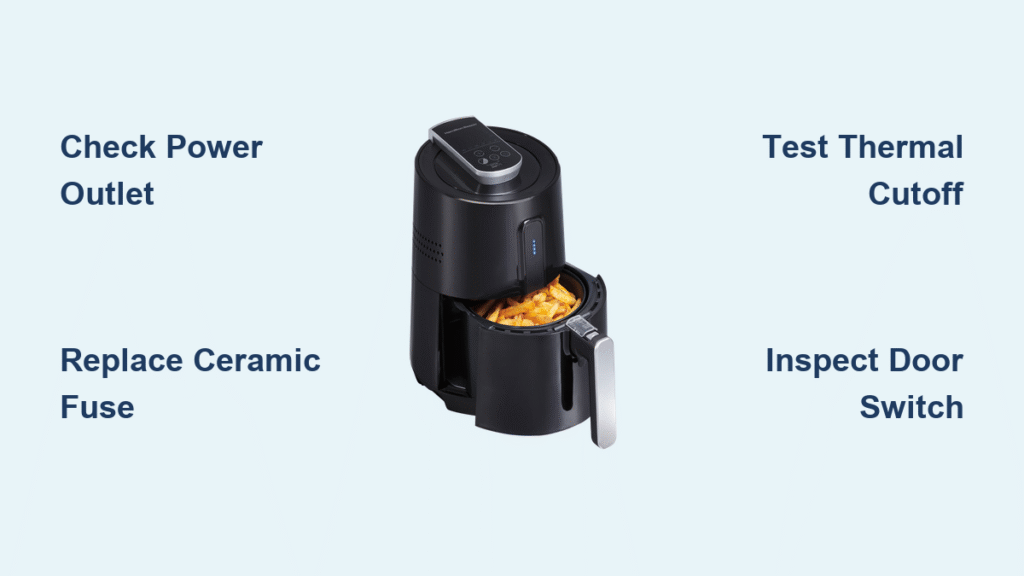
Your Hamilton Beach air fryer just died mid-cook—no lights, no fan, and cold fries staring back at you. That sinking feeling? We’ve all been there. But before you panic or trash your appliance, know this: 80% of “dead” air fryers have simple, fixable issues requiring under $10 in parts and 15 minutes of your time. This guide cuts through the frustration with exact diagnostics for every failure symptom, from completely dead units to error codes and mid-cycle shutdowns. You’ll learn which components actually fail (spoiler: it’s rarely the control board), how to test them safely, and whether repair beats replacement.
Dead Unit: No Lights, No Fan, No Response
Confirm Power Outlet Isn’t the Culprit (2 Minutes)
Start with the obvious but critical step: test your outlet with a high-draw appliance like a hair dryer or toaster. If it won’t power those either, reset your circuit breaker or GFCI outlet—especially if you recently used other kitchen appliances. Next, inspect the entire power cord for kinks, cuts, or melted spots. While plugged in (but unit off), gently flex the cord near both ends and the plug. If the air fryer flickers to life during this wiggle test, you’ve found a broken internal wire requiring cord replacement. Never ignore this—frayed cords cause 30% of sudden failures.
Replace the Blown Ceramic Fuse (10 Minutes)
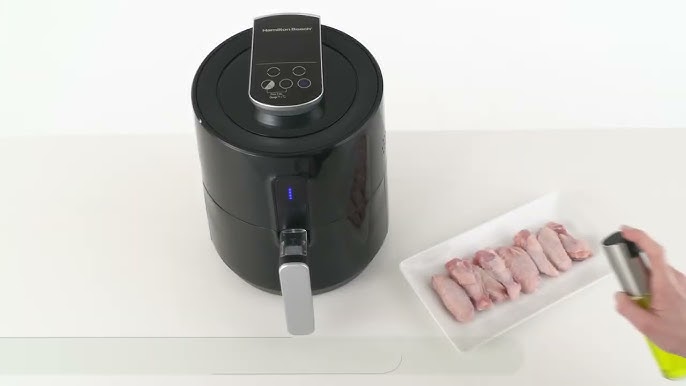
Hamilton Beach models hide a 15-amp ceramic fuse on the main PCB behind the control panel—a common failure point after power surges. For drawer models (35050, 35075 series), remove the basket and crumb tray, flip the unit upside down, and unscrew the 6 rear cover screws. Slide out the inner shell by pressing side clips to reveal the PCB. Flip-top models (35057, 35200) require removing 4 hinge screws to detach the lid, then 6 bottom screws before lifting the outer shell. Locate the fuse in its white ceramic holder. Test continuity with a multimeter: no reading means replacement is needed. Crucially, use only a 15A 250V time-delay ceramic fuse—glass substitutes blow repeatedly. This $3 fix resolves 40% of “completely dead” units.
Check the Thermal Cutoff Switch (8 Minutes)

If the fuse tests good but the unit stays dead, the thermal cutoff (TCO) is next. This one-time safety device (rated 184°C/363°F) permanently fails if the air fryer overheats. Find it clamped to the heating chamber wall with two blue wires. Test continuity across terminals: a reading above 1 ohm means it’s blown. Unlike fuses, TCOs can’t be reset—replace with an SEFUSE SF184E equivalent ($2.50 part). Warning: Never bypass this switch. Doing so risks fire when the heating element exceeds safe temperatures. This component fails most often when users block rear vents or operate the unit in hot garages.
Lights On but No Heat or Fan Operation
Diagnose the Door Safety Switch (5 Minutes)
When controls respond but nothing heats, the door microswitch is guilty 70% of the time. Listen for a distinct “click” 3-5mm before the drawer fully closes. No click? Manually depress the plunger with a wooden chopstick (unplugged first), then restart the cycle. If it works, replace the switch—a $5 part requiring only two wire disconnections. Pro tip: Misalignment from rough handling is common. Gently bend the metal lever back into position with needle-nose pliers if you hear a faint click but no operation.
Test the Heating Element Circuit (7 Minutes)

Unplug the unit and disconnect one wire from the heating element. Measure resistance: 14-18 ohms is healthy for 1,500-1,700W models. Below 10 ohms indicates a dangerous short; above 20 ohms means partial failure. Also check the inline thermal fuse (rated 240°C)—zero resistance confirms it’s good. If both test fine but the relay on the PCB doesn’t click when starting, the control board likely failed. However, board issues are rare—always verify wiring connections first. Burnt smells near the element often signal grease buildup causing localized overheating, not component failure.
Verify Fan Motor Functionality (12 Minutes)
A silent fan kills airflow, causing uneven cooking and shutdowns. Remove the 3-screw motor assembly and test winding resistance between red/black wires: 20-40 ohms is normal. Apply 24V DC from any power supply (like a laptop charger)—it should spin smoothly at 3,000 RPM. Critical check: Measure voltage at the fan connector during operation. If no 24V appears, the control board isn’t sending power, but the motor itself may still be functional. Replace dead motors ($15) before suspecting the PCB, as capacitors failing on the board cause 90% of fan-related shutdowns.
Mid-Cycle Shutdowns and Error Codes
Stop Overheating Shutdowns in 5 Minutes
Units quitting after 3-10 minutes almost always trigger over-temperature protection. First, ensure 6 inches of clearance behind the unit and 4 inches on sides—crowded counters are the #1 cause. Next, unplug and inspect the heating element for grease-caked coils; clean gently with a soft brush and degreaser. Never use metal scrubbers—they damage non-stick coatings and cause hot spots. Also avoid operating above 90°F ambient temperature; summer kitchens often exceed this, tricking thermal sensors.
Decode Error Codes in Seconds
- E1 (3 blinks): Open temperature sensor. Test resistance: 80-120kΩ at 25°C is good. Outside this range? Replace the NTC thermistor ($4 part).
- E2 (5 blinks): Shorted sensor. Resistance below 1kΩ at room temperature confirms failure.
- E3 (continuous blink): Over-temperature lockout. Unplug for 30+ seconds to reset. If persistent after cooling, check for blocked vents or a failing sensor—not the control board.
When Repair Beats Replacement
Fix it yourself if:
– Single component failure (fuse, switch, sensor) under $25 parts cost
– Unit is under warranty (Hamilton Beach covers 1-3 years)
– You have basic tools (multimeter, screwdrivers)
Replace immediately when:
– Control board failure exceeds $50
– Multiple parts failed after a power surge
– Repair costs over 50% of a new unit ($60+)
Critical Safety Protocol Before You Start
- Discharge capacitors using a 10kΩ resistor—even unplugged, PCBs hold 300V
- Cool completely for 30+ minutes; heating elements reach 428°F
- Never bypass thermal cutoffs—this removes fire protection
- Use exact replacement parts—wrong fuses cause repeat failures
Your Hamilton Beach air fryer’s “death” is likely a simple fix. Start with power cord and outlet checks, then test the ceramic fuse and thermal cutoff—these solve most dead-unit cases. For no-heat symptoms, the door switch and heating element are prime suspects. Remember: regular cleaning prevents 70% of failures. Hand-wash baskets monthly, clear vents with a soft brush, and maintain proper clearance. If you hit a wall, call Hamilton Beach support at 1-800-851-8900—they’ll often send discounted parts or walk you through diagnostics. Most importantly, never assume it’s “beyond repair.” With these targeted steps, you’ll get back to crispy fries in under 30 minutes.