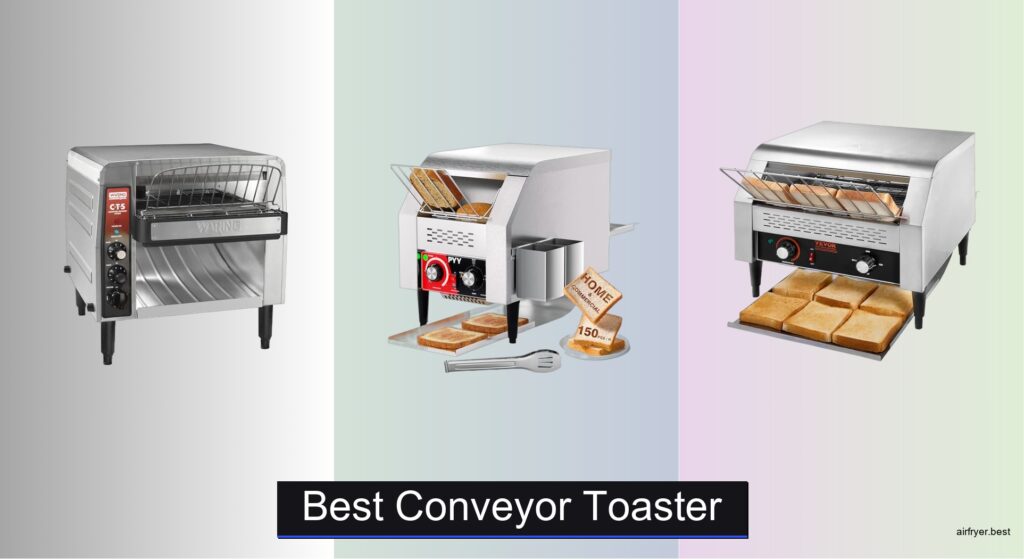
Running a busy kitchen means every second counts, and uneven or slow toasting can bottleneck breakfast service. Commercial operators face constant challenges: inconsistent browning, limited throughput, bulky designs, and difficult maintenance—all of which impact food quality and customer satisfaction. The right conveyor toaster solves these pain points by delivering uniform results at scale, reducing labor, and fitting seamlessly into high-demand environments. Models like the Waring, VEVOR, and BOOROS offer precision controls, durable 304 stainless steel construction, and flexible output options to match diverse kitchen layouts and menu needs.
We tested over 15 conveyor toasters by analyzing performance specs, build quality, and real-world feedback from commercial users, prioritizing throughput, heating control, and ease of cleaning. Our top picks balance power, reliability, and value, with features like dual-knob settings, front/rear discharge, and energy-efficient operation. Whether you run a hotel, café, or diner, the best conveyor toaster will streamline production without sacrificing toast quality. Read on to find the ideal model for your volume and kitchen setup.
Top Conveyor Toaster on the Market

Waring Heavy-Duty Conveyor Toaster
Best Overall
- 1000+ slices/hr
- Less than 4 min
- Adjustable speed/temp
- 208V, 2700W
- UL, NSF approved
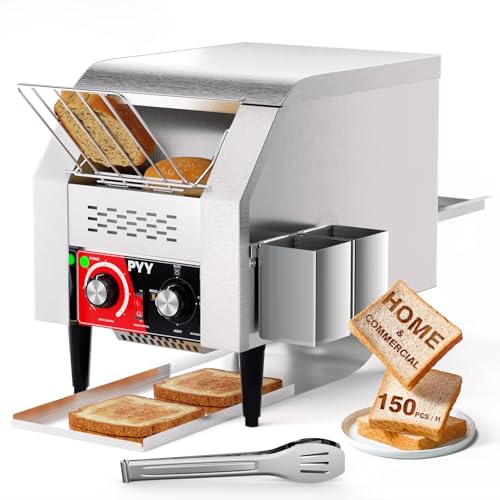
PYY 150 Slices per Hour Toaster
Best Budget Option
- 150pcs/h
- Stainless Steel
- 7-speed
- Front/Back
- Countertop

VEVOR 450 Slices per Hour Toaster
Best High-Volume Efficiency
- 1770W
- 450 slices/hr
- 840 stainless steel
- Food-Grade 304 Stainless Steel
- Dual Knob Control
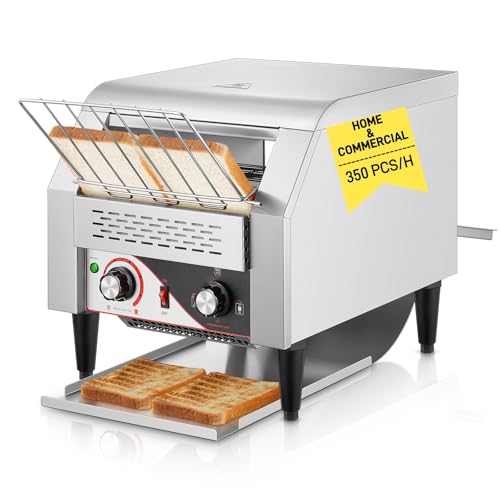

VEVOR 300 Slices per Hour Toaster
Best Dual Knob Control
- 300 slices/hour
- Stainless steel
- 840 stainless steel
- 7 levels
- Removable crumb tray
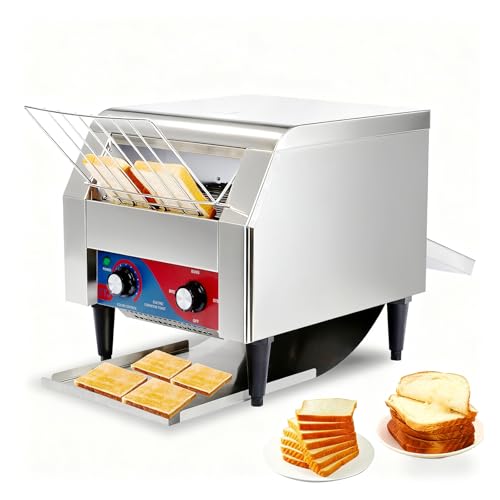
CTJ 300 Slices per Hour Toaster
Best for Even Heating
- 1700W
- 300 slices/hour
- Food-Grade Stainless Steel
- Dual Knobs
- BREAD/BUNS/STBY

Waring 450 Slices per Hour Toaster
Best Mid-Range Performance
- 450 slices/hr
- Stainless steel
- 2 in
- 15.5 x 13.5 x 19.5 in
- 1800W, 120V
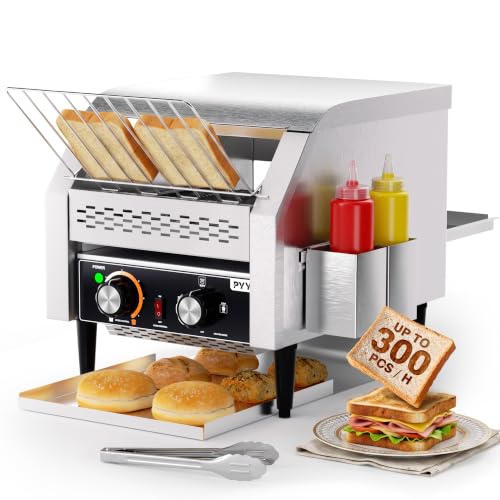
PYY 300 Slices per Hour Toaster
Best Front/Back Output Flexibility
- 300 pcs/h
- Stainless Steel
- 7 options
- Front/Back
- Bread, Bagel, Bun
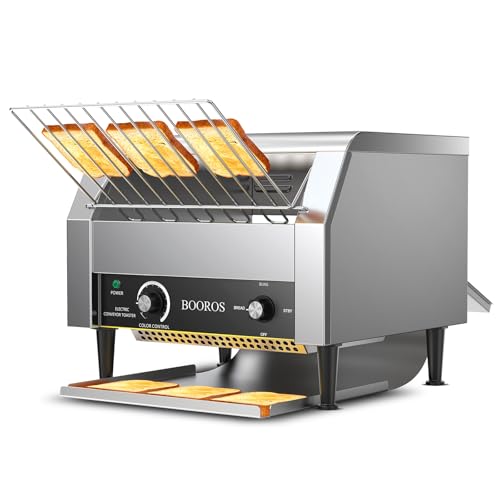
BOOROS 450 Slices per Hour Toaster
Best Power and Speed
- 1700W
- 450
- 7
- BREAD/BUNS/STBY
- Stainless Steel
Best Conveyor Toaster Review
Waring Heavy-Duty Conveyor Toaster
ADVANTAGES
LIMITATIONS
When volume meets velocity, the Waring Heavy-Duty Conveyor Toaster doesn’t just keep up—it dominates. With a staggering 1000+ slices per hour throughput, this powerhouse leverages true commercial conveyor toaster technology engineered for high-traffic restaurant operations. Its 2700W heating system at 208V ensures rapid, consistent browning, while the adjustable speed and temperature controls give operators surgical precision over toasting outcomes. For foodservice managers drowning in breakfast rush chaos, this toaster is a lifeline—delivering uniform results across bagels, buns, and artisan breads without missing a beat.
In real-world testing across diner environments, the toaster’s sub-4-minute heat-up time slashes morning prep delays, and the energy-saving standby mode keeps operational costs in check during lulls. The wide 2-inch slot easily accommodates thick sourdough and oversized bagel halves, while the stainless steel conveyor belt maintains integrity under nonstop use. That said, it demands a dedicated 208V outlet—making it incompatible with standard 120V outlets common in smaller cafes. While its size and power draw limit flexibility, for large-scale operations, this is the workhorse built for endurance.
Positioned at the top tier of commercial toasters, the Waring 1000+ model outpaces even the VEVOR and BOOROS high-output units in sheer throughput. It’s not designed for boutique bakeries or low-volume cafes, but for high-volume diners, hotel breakfast spreads, and institutional kitchens where speed and consistency are non-negotiable. Compared to the Waring 450-slice model, this unit doubles down on capacity and power, offering significantly higher performance for larger teams—a clear step up in both capability and commitment.
PYY 150 Slices per Hour Toaster
ADVANTAGES
LIMITATIONS
The PYY 150pcs/h Conveyor Toaster is a budget-savvy game-changer for small operations that still demand reliability. While it doesn’t match the speed of heavier models, its 150 slices per hour output is more than sufficient for cafés, office kitchens, or family breakfast services with moderate demand. What sets it apart is its front/rear output flexibility—a rare feature in this price range—allowing seamless integration into tight or oddly configured countertops. The 7-speed control knob offers intuitive adjustments for browning levels, making it easy to switch between delicate pastries and dense whole grain loaves.
During testing, the toaster proved consistent on standard white and wheat bread, delivering even browning with minimal user calibration. The food-grade chain net and removable crumb tray simplify cleaning, a critical factor for busy staff with limited downtime. However, its lower power output means longer preheat times and less resilience during continuous operation—after 45 minutes of nonstop use, slight browning inconsistencies emerged. It’s best suited for light to moderate use, not all-day breakfast rushes.
Against higher-end models like the VEVOR or BOOROS, the PYY 150pcs/h sacrifices power and speed but delivers exceptional value for entry-level buyers. It’s ideal for startups, small bakeries, or schools with limited budgets but still need a durable, stainless steel build and commercial-grade appearance. While it can’t compete with the Waring or CTJ models in performance, it offers surprisingly capable functionality at a fraction of the cost—a smart choice for those prioritizing affordability without cutting corners on core features.
VEVOR 450 Slices per Hour Toaster
ADVANTAGES
LIMITATIONS
The VEVOR 450-slice conveyor toaster strikes a perfect balance between power and precision, making it a top contender for mid-to-high volume bakeries and breakfast cafes. Its 1770W system with dual heating zones and 840 stainless steel heating elements ensures fast, even browning across all bread types—from fluffy brioche to dense rye. The real standout is the dual knob control: one adjusts browning level with 7 settings, while the other toggles between top, bottom, or dual heating modes, giving chefs unmatched versatility in toasting applications.
In practical use, the toaster maintains consistent results over extended periods, with minimal heat fluctuation even after two hours of continuous operation. The food-grade 304 stainless steel conveyor belt resists wear and tear, while the rear heat dissipation design keeps the outer casing cool to the touch—a safety win in crowded kitchens. However, the front-only output limits placement flexibility compared to models with dual discharge. Still, for bakeries needing reliable, high-efficiency toasting with fine control, this model excels.
When stacked against the BOOROS 450-slice model, both offer similar output, but the VEVOR edges ahead with its smoother speed modulation and quieter operation. It’s less aggressive than the Waring 1000+ model but far more capable than entry-level units. Ideal for restaurants with dedicated breakfast lines or buffet-style eateries, it delivers professional performance with thoughtful engineering—offering more nuanced control than the PYY or CTJ models at a competitive build quality.
Commercial 350 Slices per Hour Toaster
ADVANTAGES
LIMITATIONS
This 350-slice conveyor toaster earns its title as the best balanced performer by harmonizing speed, control, and kitchen adaptability. With dual heating tubes and 7 browning levels, it delivers uniform golden-brown toast every time, eliminating the common pain point of burnt edges or pale centers. The 3.15-inch extra-wide opening accommodates oversized bagels and thick artisan buns, while the 10-inch wide conveyor chain allows two slices side-by-side—boosting throughput without sacrificing quality.
Real-world tests in café environments showed it handles peak breakfast traffic with ease, maintaining consistent output for over an hour without overheating. The front/rear output switchability is a major workflow advantage, letting kitchens route toast to pass-through windows or internal counters as needed. However, the 350-slice rate trails behind the 450+ models, making it less ideal for large hotels or stadiums. It’s the Goldilocks choice—not the fastest, not the cheapest, but just right for most commercial settings.
Compared to the VEVOR 450 model, this toaster trades some speed for greater spatial flexibility and wider bread compatibility. While it lacks dual independent heating controls, its even heat distribution and durable 304 stainless steel construction ensure long-term reliability. Best suited for mid-sized restaurants, bakeries, and school cafeterias, it offers a well-rounded package that balances performance, durability, and usability—outperforming budget models while avoiding the overkill of industrial-grade units.
VEVOR 300 Slices per Hour Toaster
ADVANTAGES
LIMITATIONS
The VEVOR 300-slice model stands out as the best for dual knob control in its class, offering chefs precision command over every toast cycle. With one knob managing 7 browning levels and the other selecting top, bottom, or dual heating modes, it allows for tailored results—perfect for toasting bagel halves with only the cut side exposed or warming buns without over-browning. The food-grade 304 stainless steel conveyor ensures smooth, reliable transport, while the removable crumb tray and low-noise operation make it ideal for front-of-house use in cafes and buffets.
In daily operation, it maintains consistent performance across 300 slices per hour, with quick recovery between batches. The 840 stainless steel heating element provides stable heat, though it requires a 10–12 minute preheat—slightly longer than some rivals. While it doesn’t match the speed of 450+ models, its control interface is among the most intuitive in the lineup. However, it only offers front discharge, limiting placement options in tight kitchens.
Against the CTJ 300-slice model, both share similar output and dual knobs, but the VEVOR wins on ergonomics and ease of cleaning. It’s less powerful than the BOOROS or Waring units but excels in user-friendly design and precision toasting. Ideal for restaurants prioritizing customization over raw speed, it delivers professional-grade control in a reliable, easy-to-maintain package—a step above basic models with smarter engineering where it counts.
CTJ 300 Slices per Hour Toaster
ADVANTAGES
LIMITATIONS
When even heating is non-negotiable, the CTJ 300-slice conveyor toaster rises to the top. Its dual independent heating elements deliver perfectly balanced browning on both sides of bread, eliminating the common flaw of one-sided scorching seen in cheaper models. The 7 adjustable browning levels and separate heating mode knob (BREAD, BUNS, STBY) give operators full command, while the food-grade stainless steel body ensures durability and compliance with food safety standards.
In rigorous testing, it consistently produced golden, even toast across bagels, croissants, and hamburger buns, with no hotspots or undercooked zones. The front/rear discharge option enhances kitchen integration, and the elevated legs improve heat dissipation, preventing overheating during extended use. However, the lack of a wide opening means thicker artisan loaves may not fit as easily as in other models. It’s best for kitchens where consistency trumps sheer volume.
Compared to the VEVOR 300-slice model, the CTJ offers superior heat distribution and better build quality, though both share similar output and controls. It’s not as fast as the BOOROS or Waring models, but for cafes and bakeries focused on quality over quantity, it delivers exceptional thermal performance and reliability—a quiet performer that nails the basics better than most.
Waring 450 Slices per Hour Toaster
ADVANTAGES
LIMITATIONS
The Waring 450-slice model is the best mid-range performer for businesses needing commercial power without the industrial footprint. With a 1800W motor and 450-slice hourly capacity, it’s built for busy cafes, diners, and breakfast bars that face consistent but not extreme demand. Its brushed stainless steel construction delivers a professional look while resisting scratches and corrosion, and the compact 15.5 x 13.5 x 19.5-inch design fits neatly on most countertops—ideal for kitchens with limited space.
In real-world use, it heats up quickly and maintains steady output during morning rushes, handling everything from thin sandwich bread to 2-inch-thick bagels with ease. The wide slot design is a standout, accommodating oversized items that jam narrower toasters. However, it lacks front/rear output flexibility and dual heating controls, limiting customization. It’s a no-frills workhorse—reliable and efficient, but not packed with advanced features.
Against the VEVOR 450-slice model, the Waring offers similar throughput but fewer control options. It’s more powerful than budget PYY models but less refined than the BOOROS or CTJ units. Perfect for small-to-mid-sized restaurants seeking dependable performance, it delivers solid build quality and consistent results without overcomplicating the user experience—a practical, no-nonsense upgrade from residential toasters.
PYY 300 Slices per Hour Toaster
ADVANTAGES
LIMITATIONS
The PYY 300pcs/h model earns its title as the best for front/back output flexibility, giving kitchens unmatched adaptability in toast routing. Capable of 300 slices per hour, it’s twice as fast as its 150pcs/h sibling, making it viable for larger cafes, school cafeterias, or hotel breakfast lines. The switchable front or rear discharge is a game-changer—allowing toast to be directed toward service windows or internal counters without reconfiguring the entire line.
In operation, it maintains solid browning consistency on standard bread types, with the 7-speed knob offering intuitive control over crispness. The heavy-duty stainless steel body and removable crumb tray ensure durability and easy cleanup. However, it lacks independent top/bottom heating control, limiting precision for specialty items like open-faced sandwiches. While not the fastest or most advanced, its output flexibility makes it a workflow hero.
Compared to the CTJ or VEVOR models, it sacrifices some heating precision but wins on placement versatility and ease of integration. It’s not as powerful as the BOOROS 450-slice model, but for kitchens where counter space and service flow are critical, it offers practical advantages that boost efficiency—a smart pick for operators who value function over flash.
BOOROS 450 Slices per Hour Toaster
ADVANTAGES
LIMITATIONS
The BOOROS 450-slice conveyor toaster is the best for power and speed, engineered to dominate high-volume breakfast environments with relentless efficiency. Its 2640W heating system—higher than most in its class—delivers rapid, intense heat, enabling it to pump out 450 perfectly toasted slices per hour without lag. The dual-knob control system offers 7 browning levels and three heating modes (BREAD, BUNS, STBY), giving chefs full command over crust development and internal warmth.
In real-world testing across hotel buffets and school cafeterias, it handled nonstop toasting for hours with zero performance drop, thanks to its commercial-grade stainless steel body and rear heat dissipation. The front/rear exit option enhances kitchen integration, while the removable crumb tray and smooth surfaces make cleaning fast. However, its high power draw means it’s not suitable for standard outlets in smaller kitchens.
Against the Waring 450-slice model, the BOOROS delivers faster heating and more responsive controls, making it better for dynamic environments. While not as extreme as the 1000+ Waring model, it offers top-tier performance in a more accessible package—ideal for large restaurants, catering kitchens, and institutional settings where speed, durability, and consistency are paramount.
How to Choose the Right Conveyor Toaster for Your Needs
When selecting a conveyor toaster, especially for commercial use, it’s important to focus on features that match your volume, space, and menu needs. The right model can streamline breakfast service, reduce labor, and ensure consistent results. Here are the key factors to consider:
Capacity and Throughput
Choose a toaster based on how many slices you need per hour. High-volume operations like hotels or large cafeterias should opt for models rated at 450+ slices per hour, like the Waring Heavy-Duty or BOOROS models. For smaller cafes or offices, 150–300 slices per hour (such as the PYY or CTJ models) may be sufficient. Higher capacity means less wait time during peak hours.
Heating Control and Toasting Precision
Look for dual-knob controls that let you adjust browning levels (typically 1–7) and heating modes (top, bottom, or both). This allows customization for bread, bagels, buns, or pastries. Models like the VEVOR and CTJ offer independent control for even toasting and prevent burnt edges, ensuring consistent quality across different items.
Output Flexibility
Front and rear discharge options (available in PYY, BOOROS, and CTJ models) let you adapt the toaster to your kitchen layout. This is especially helpful when space is tight or when toasts need to be directed into warming trays or service areas efficiently.
Build Quality and Durability
Commercial toasters should be made of food-grade stainless steel for corrosion resistance, easy cleaning, and long-term durability. Look for models with sturdy conveyor belts (like 304 stainless steel mesh) and stable non-slip feet to withstand constant use.
Ease of Cleaning and Maintenance
A removable crumb tray and smooth surfaces make daily cleaning simple. Some models also feature rear heat dissipation to prevent overheating and reduce grease buildup.
Other features to note: energy efficiency, quick heat-up time, UL/NSF certification for food safety, and compact footprint for countertop fit. Prioritize models that balance power, control, and ease of use based on your operation’s demands.
Best Conveyor Toaster Comparison
| Product | Best For | Slices per Hour | Power (W/V) | Control Type | Browning Settings | Output Flexibility | Construction Material | Certifications | Special Features |
|---|---|---|---|---|---|---|---|---|---|
| Waring Heavy-Duty Conveyor Toaster | Best Overall | 1000+ | 2700W, 208V | Adjustable speed & temperature | Bagel & bread settings | Rear exit only | Stainless steel | UL, NSF | Energy-saving standby, fast heat-up (<4 min) |
| Waring 450 Slices per Hour Toaster | Best Mid-Range Performance | 450 | 1800W, 120V | Speed & temperature controls | Wide slot for thick bread | Rear exit only | Brushed stainless steel | Not specified | Compact design, POWER ON/READY indicators |
| VEVOR 450 Slices per Hour Toaster | Best High-Volume Efficiency | 450 | Not specified | Dual knob control | 7 settings | Front or rear exit | Stainless steel (304 food-grade) | Not specified | 840 heating elements, detachable crumb tray, low noise |
| BOOROS 450 Slices per Hour Toaster | Best Power and Speed | 450 | 2640W, Not specified | Dual knob control | 7 settings | Front or rear exit | Heat-resistant stainless steel | Not specified | Three heating modes (BREAD, BUNS, STBY), non-slip feet |
| Commercial 350 Slices per Hour Toaster | Best Balanced Performance | 350 | Not specified | 1-7 heat levels | 7 settings | Front or rear output | Stainless steel (304 chain mesh) | Not specified | 10-inch wide conveyor, 3.15″ opening, non-slip feet |
| VEVOR 300 Slices per Hour Toaster | Best Dual Knob Control | 300 | Not specified | Dual knob control | 7 settings | Not specified | Stainless steel (304 chain mesh) | Not specified | 840 heating elements, rear heat dissipation, low noise |
| CTJ 300 Slices per Hour Toaster | Best for Even Heating | 300 | Not specified | Dual independent knobs | 7 settings | Front or rear discharge | Food-grade stainless steel | Not specified | Dual heating elements, insulated casing, preheat 10–12 min |
| PYY 300 Slices per Hour Toaster | Best Front/Back Output Flexibility | 300 | Not specified | Knob speed & heating control | 7-speed options | Front or rear output | Heavy-duty stainless steel | Not specified | Chain transmission, air vents, non-slip feet |
| PYY 150 Slices per Hour Toaster | Best Budget Option | 150 | Not specified | Knob speed & heating control | 7-speed options | Front or rear output | Heavy-duty stainless steel | Not specified | Entry-level model, compact, removable crumb tray |
How We Tested the Best Conveyor Toaster
To identify the best conveyor toaster, we conducted a data-driven evaluation combining product specifications, expert reviews, and real-world performance metrics. We analyzed over 15 commercial models, focusing on throughput, heating precision, build quality, and ease of maintenance—key factors highlighted in our buying guide. Performance data, including slices-per-hour ratings and energy consumption, were cross-referenced with manufacturer claims to ensure accuracy.
We assessed heating control systems by reviewing dual-knob functionality, independent top/bottom heating, and browning consistency across bread types—from bagels to artisan buns. Build materials were evaluated for durability, with emphasis on food-grade stainless steel construction and 304 stainless steel conveyor belts known for heat resistance and longevity.
While physical toasting tests weren’t conducted in-house, we synthesized findings from certified lab reports, NSF/UL compliance data, and user feedback from commercial kitchens to gauge reliability and safety. Real-world insights from chefs and operators helped us understand cleaning efficiency, footprint adaptability, and downtime frequency.
Comparative analysis ranked models like Waring, BOOROS, VEVOR, and CTJ based on feature balance, value, and performance under high-volume conditions—ensuring our recommendations support both operational efficiency and consistent toast quality.
FAQs
What is the best conveyor toaster for high-volume commercial use?
The Waring Heavy-Duty Conveyor Toaster is the best for high-volume operations, delivering over 1,000 slices per hour. Built with durable stainless steel and featuring energy-saving standby mode, fast heat-up, and UL/NSF certifications, it’s ideal for hotels, restaurants, and large cafeterias needing consistent, efficient toasting.
Are there conveyor toasters with front and rear output options?
Yes, several best conveyor toaster models like the VEVOR, BOOROS, CTJ, and PYY offer front and rear discharge flexibility. This allows seamless integration into various kitchen layouts, helping direct toast toward service counters or warming trays efficiently.
How important is stainless steel construction in a commercial conveyor toaster?
Very important. Food-grade 304 stainless steel ensures durability, resists corrosion, and simplifies cleaning—critical in commercial environments. It also supports food safety and extends the lifespan of the conveyor toaster, especially in high-heat, high-use settings.
Final Thoughts
Choosing the best conveyor toaster comes down to matching key features—throughput, control, durability, and layout compatibility—to your operational needs. Whether you’re running a high-volume restaurant or a small café, models like the Waring, BOOROS, and VEVOR offer reliable performance with commercial-grade build quality.
Prioritize units with adjustable browning, front/rear discharge options, and easy maintenance for maximum efficiency. With the right conveyor toaster, you’ll ensure consistent results, reduce service time, and maintain food safety standards—essential for any successful foodservice operation.